


The Oldest Dinosaurs on Earth Exhibition
- Date
- 2010.10.09 (Sat) - 11.28 (Sun)
- Time
- 10:00 AM - 17:00 PM (Last entry at 16:30 PM)
- Venue
- ATC Museum
- Price
- General: 1,400 yen
College / High school students: 1,000 yen
Junior high school students/Elementary school students: 500 yen
*Group tickets for 20 or more people are also available at the venue. General admission: 1,100 yen/person
University/High school students: 700 yen/person Junior high/Elementary school students: 300 yen/person
*Visitors with a disability certificate and their caregiver (up to one person) will receive a 1% discount on admission fees on the day of their visit.
*Children who have not yet entered elementary school are admitted free of charge.
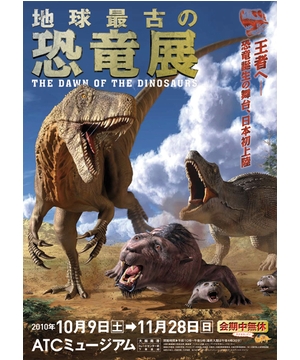
The world of dinosaurs and other creatures, introduced to Japan for the first time, will appear at ATC this autumn! Explore how dinosaurs originated and ruled the world approximately 230 million years ago.
Enjoy this first-ever opportunity in Japan to see a comprehensive collection of the latest research findings (approximately 23 species and 80 items, including world premieres) that unravel the mystery of the origin of dinosaurs.
The ancestor of crocodiles: Saurosuchus
Measuring approximately 7 meters in length, it was discovered in the Ischigualasto Formation from the Late Triassic period. It is a species of crurotarsi, an ancestor of crocodiles, and was one of the largest carnivorous animals of the Late Triassic. At that time, the ancestors of crocodiles looked very different from those of today and were highly diversified. For about 30 million years during the Late Triassic period (approximately 228.7 million to 199.6 million years ago), dinosaurs and crocodiles seem to have competed for the same ecological niche. Considering only the Late Triassic period, these crurotarsi could be said to be the most dominant animals. The carnivorous Saurosuchus may have sometimes attacked and eaten dinosaurs. Modern crocodiles are known to have a respiratory system similar to that of birds, which are descendants of dinosaurs (they have multiple pump-like organs called air sacs in addition to lungs, allowing them to breathe efficiently). It is possible that ancestors of crocodiles like Saurosuchus also had a superior metabolic system, similar to that of dinosaurs.
The ancestor of mammals: Exaeretodon
This cynodont was discovered in 1943 in the Ischigualasto Formation. It is an ancestor of mammals, measuring approximately 2.4 meters in length. It is a type of so-called mammalian reptile (synapsid) that appeared in the Late Carboniferous period (between approximately 318.1 million and 299 million years ago). Synapsids are classified into two types: pelycosauria and therapsids. Therapsids are closer to modern mammals, and cynodonts are a group within them. Mammals originated from these cynodonts in the Late Triassic period. In the Late Triassic, Exaeretodon and its relatives spread and thrived throughout the supercontinent Gondwana, which included South America and Africa, mainly in the Southern Hemisphere. Analysis of fossils and other evidence indicates that they were warm-blooded animals with hair all over their bodies, and their offspring required parental care. Even before diverging into mammals, they had already acquired characteristics common to us mammals.
The oldest dinosaur on Earth: Frenguelisaurus
Discovered in San Juan in 1986, this bipedal carnivorous dinosaur measured approximately 6 meters in length. It was named after the Argentine paleontologist Dr. Joaquin Frenguelli. Although it was once thought to be a primitive theropod, the discovery of many early-type dinosaurs has revealed that, like Herrerasaurus, it is a primitive dinosaur that existed before the divergence of theropods.
Discovered in a 228-million-year-old geological layer, Frenguelisaurus is currently one of the oldest known dinosaurs on Earth. It was the largest carnivorous dinosaur in the Ischigualasto Formation of San Juan, and it likely used its powerful jaws to prey on weaker creatures, such as the reptiles Hyperodabedon (Scaphonyx), which are found in large numbers in the same layer.